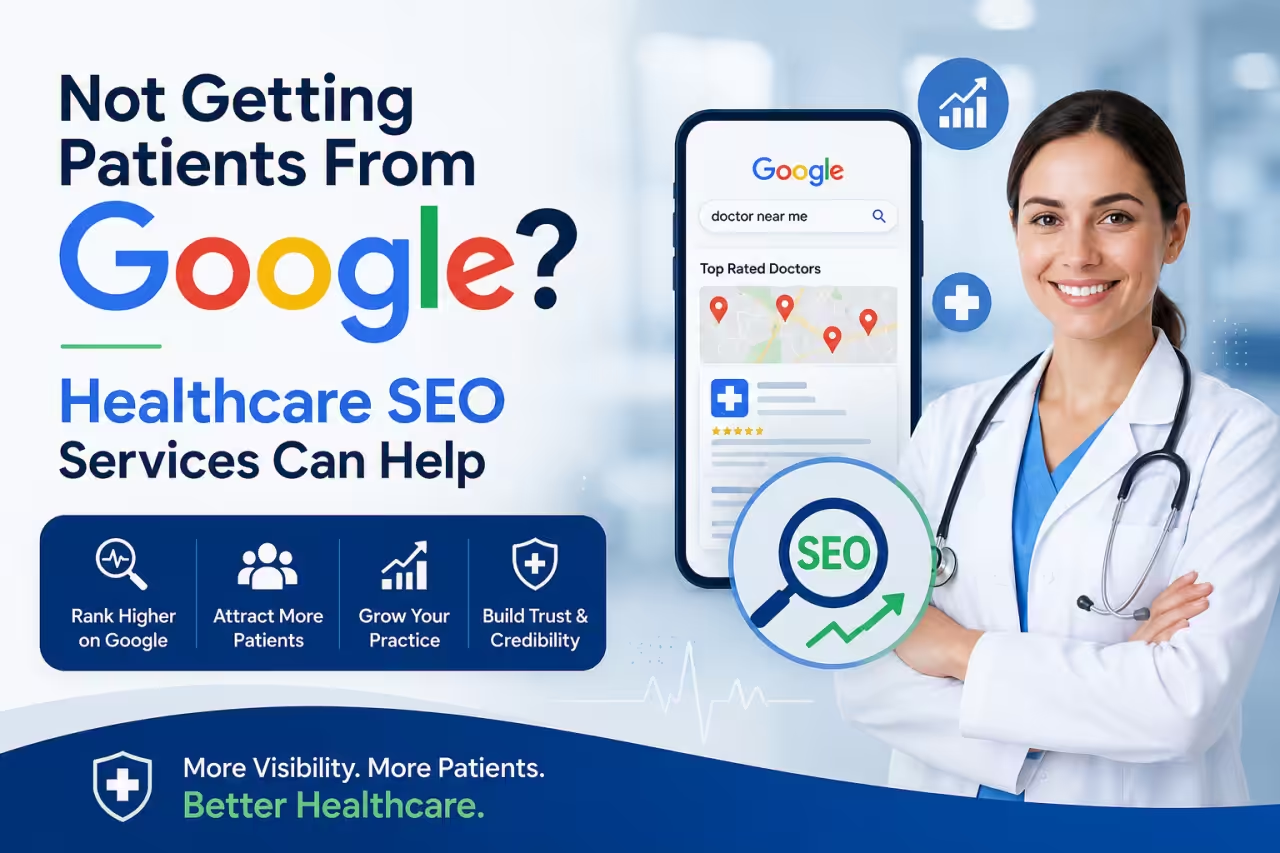
If your healthcare website gets little traffic from Google, you may have a bigger problem than low website visits. You may be losing patients before they ever discover your clinic, hospital, doctor, or healthcare service.
As per my research, people increasingly use Google when they need healthcare information and want to find a provider.In 2024, a survey said 46% of patients rely on Google to look for a new doctor.
That means when people search for care, other practices can show up first if your site is not there. Then those patients may pick a competitor before they ever visit you.
This is where healthcare SEO services can help. SEO is more than trying to boost rankings. With a solid healthcare SEO plan, your site shows up when patients look for answers. They search for issues, care options, doctors, clinics, and specific services you offer.
The Problem: Your Healthcare Website Is Not Reaching Potential Patients
I keep running into healthcare sites that look polished, but they do not get much steady traffic from search. These sites may list doctors, treatments, and other services. Still, Google often does not place the key pages where people can find them.
What causes this?
From what I have seen, the usual issues are technical SEO problems, thin or weak pages for services, keyword targeting that misses the mark, slow loading speed, not enough local SEO work, and internal links that are not set up well. Another common factor is content that does not line up with what patients type into Google.
For example, a clinic may create a page called “Our Services.” That sounds fine from a business perspective, but patients may search for “knee pain specialist near me,” “best physiotherapy clinic,” or “sports injury treatment.”
Google needs clear signals to understand which page answers each search.
This means you can have an excellent medical team and still remain difficult to find online.
The problem becomes more serious because healthcare searches often carry strong intent. Someone searching for a doctor, diagnostic test, treatment, or clinic may already want to take action.
If your website does not appear, another healthcare provider can receive that patient.
The Agitation: Every Missing Search Can Become a Missed Patient
Let me put this into a simple situation.
Imagine someone searches Google for a treatment you provide. Your competitor appears on page one. Your website appears on page four.
The patient may never reach page four.
Picture it happening a lot each month, not just once. It could be hundreds of times. It could be even more. Your site still stays up. Your doctors still see patients and keep doing solid work. Your marketing team still posts new content.But potential patients keep choosing businesses that they can find more easily.
As per data available from Think with Google, 77% of patients used search before scheduling a hospital appointment in the research cited by Google. The same research also found that patients who scheduled appointments conducted about three times as many searches as those who did not.
This tells me something important: search can play a meaningful role before a healthcare decision.
The issue is not only traffic. You also need the right traffic.
Getting visitors who search for general information may help awareness, but healthcare SEO should also target searches connected to services, locations, conditions, treatments, and appointments.
That requires a more focused approach.
The Solution: Healthcare SEO Services Built Around Patient Search
This is where professional healthcare SEO services can change the situation. The first step should involve research. I would start by understanding what patients search for, which services generate revenue, which locations you serve, and where your website currently loses visibility.
Then I would map those searches to the right pages.
A treatment keyword should lead to a useful treatment page. A doctor-related search should lead to a strong doctor profile. A local search should lead to a properly optimized location page.
The technical side also matters.
If your site has crawl issues, dead links, messy page structure, slow load speed, duplicate pages, or trouble getting indexed, Google might not be able to read it well.
That can hurt your rankings.
A technical SEO expert can help. They spot issues that you may not notice when you view the site in a browser. These fixes can change how search engines crawl, store, and interpret your pages.
What the Data Says About Healthcare SEO
I do not believe healthcare SEO should rely on promises such as “we will get you thousands of visitors.” I prefer measurable evidence.
A recent healthcare SEO case study says a multi-specialty clinic saw a 350% rise in organic traffic within 12 months. The work centered on fixing technical issues, reshaping the site, mapping keywords, improving content, adding internal links, and strengthening local SEO.
In another healthcare SEO story, a medical platform grew from about 25,000 monthly organic visits to over 100,000 in a year.
A healthcare provider shared another case study. After an SEO effort, it saw 320% more organic traffic. It also reported a 739% rise in ranking keywords. Total impressions went up by 5,065%.
Still, these results are not a promise for every healthcare company. Performance can swing based on how crowded the market is. It can also depend on where the business is located, what service area it focuses on, how strong the website already is, how much money is spent, and how well the work is carried out.
From what I saw in the research, the core trend stays the same. Healthcare sites tend to get more organic reach when teams handle technical issues, publish content that people actually need, aim for searches that match their services, and improve how much trust the site earns.
Why Technical SEO Matters More Than You Think
Many businesses focus almost entirely on blog writing.SEO matters, yet it is not a cure for everything.If search engines cannot crawl your site or add it to their index, more posts will not fix that.
A technical SEO specialist can check how the site is built and how pages are handled.
They look at things like navigation structure, indexing rules, redirect setups, canonical tags, and schema markup. They also review mobile usability, how fast pages load, and how links move users from page to page. To me, technical SEO is the base layer.
Once the foundation works properly, content and authority-building efforts can perform better.
For healthcare websites, this matters even more because the website needs to communicate expertise and trust clearly.
What About PPC and Paid Traffic?
SEO and paid advertising can work together.
SEO can help build long-term organic visibility, while PPC can help you reach people quickly for selected services and locations.
Some healthcare marketing agencies also provide white label PPC services, allowing agencies to offer paid advertising under their own brand while another specialist team handles campaign execution.
This can make sense for marketing agencies that want to offer healthcare clients both SEO and PPC without building a large in-house PPC department.
However, I would not treat PPC as a replacement for SEO.
Paid ads stop generating traffic when the advertising budget stops. SEO can continue generating organic visibility after the initial work, although it requires ongoing maintenance and investment.
The Future of Healthcare Search Is About Being Useful
The future of healthcare content writing will not depend only on publishing more articles.
Healthcare brands should respond to patient questions in a clear way. They need to show that they truly know what they are talking about. The details they share must be correct. It should also be simple for people to choose what to do next.
At the same time, search keeps shifting. Google is adding more AI-generated results and experiences.Recent changes to Google Search show that AI Overviews can occupy prominent space before traditional results, which makes clear, useful, trustworthy content even more important.
As per my experience, healthcare brands should stop asking only, “What keyword should we rank for?”
A better question is, “What problem is the patient trying to solve, and can our website provide the best answer?”
That shift can improve both SEO and the patient experience.
Final Thoughts
If your healthcare website is not bringing patients from Google, the answer may not be another random blog post.
You need to understand where the problem starts.
Maybe Google cannot properly understand your website. Maybe your service pages target the wrong keywords. Maybe your competitors have stronger local visibility. Maybe your content does not answer real patient questions.
Maybe your site needs elp from a technical SEO expert. That is where solid healthcare SEO services come in. They should cover technical fixes, writing that patients can read, and careful keyword work. They also need local SEO so people nearby can find you.
Beyond that, they should build trust and improve how visitors turn into leads.
As per my research, patients already use search during the healthcare decision-making process. The real opportunity is to make sure your healthcare business appears when those searches happen.
Other firms are earning clicks, yet your pages do not show up. That usually means people are not seeing you, not that they are not looking.