Claudia Reyes used to budget twenty minutes before every important client call just to sort out the technology. The conference room on the fourteenth floor had a projector that required a dongle nobody could ever find, a speakerphone that picked up the air conditioning better than human voices, and a whiteboard covered in diagrams from a session two weeks prior that nobody had photographed before erasing. When remote participants joined, they did so through a personal laptop propped on a stack of books because the room had no dedicated camera. Claudia’s company wasn’t a struggling startup. It was a 600-person professional services firm with a facilities budget that ran to seven figures annually. The problem wasn’t money. It was that nobody had thought about the meeting room as a technology environment that needed the same deliberate design attention as the software tools the teams inside it used every day. The transition to smart meeting rooms changed that calculus entirely, and the firms that have made that transition are operating with a measurably different standard of collaboration than the ones still hunting for dongles.
The Gap Between Meeting Room Promise and Meeting Room Reality
Most organizations have experienced some version of Claudia’s problem, even if the specific friction points differ. A survey of knowledge workers consistently finds that technology failures are among the top three causes of meeting inefficiency, alongside unclear agendas and poor facilitation. The time lost to setup, troubleshooting, and workarounds compounds invisibly across thousands of meetings per year into a significant productivity drain that rarely appears as a line item in any budget analysis.
The traditional meeting room was designed around a projector, a speakerphone, and a whiteboard. Those tools were adequate for a workforce that was almost entirely on-site, where the remote participant was the exception rather than a standing feature of nearly every meeting. The hybrid workplace changed the distribution fundamentally. When half the participants in any given meeting are joining remotely on a permanent basis, the room that was designed for the occasional dial-in caller becomes structurally inadequate for the work it’s being asked to support.
Closing that gap is what meeting room technology at its current level of sophistication is actually designed to do. Not to add complexity, but to remove the friction that accumulates when the physical environment doesn’t match the collaborative reality of how teams actually work.
What a Smart Room Actually Contains
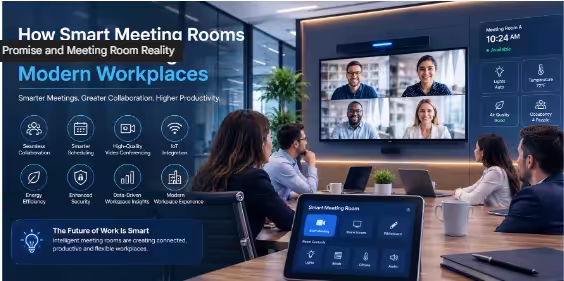
The components that define a genuinely smart meeting room form an integrated system rather than a collection of individual devices. Understanding how they work together explains why the difference between a room with good individual components and one with a properly integrated system is larger than the sum of the parts.
The display layer has evolved from single projectors to multi-display configurations that simultaneously serve in-room participants and remote attendees without requiring either group to compromise on visibility. Interactive flat panels with touch capability replace passive projection surfaces, allowing annotation, content manipulation, and whiteboarding that persist digitally rather than disappearing when the cleaner wipes the board between sessions.
The audio layer is where most room experiences fail or succeed. Beamforming microphone arrays that track active speakers around the table, combined with acoustic echo cancellation and noise suppression processing, mean that a remote participant hears the person speaking clearly regardless of where in the room they’re sitting. For Claudia’s team, this single change produced the most immediate and visible improvement in meeting quality, because remote participants stopped asking people to repeat themselves.
The camera layer now includes AI-driven framing that keeps active speakers centered in frame automatically, presenter tracking that follows movement across the front of the room, and multi-camera configurations that switch intelligently based on who is speaking. These capabilities, delivered through AV collaboration solutions that integrate the camera system with the room’s audio processing, eliminate the static wide-angle shot that made remote participants feel like they were watching a surveillance feed rather than participating in a conversation.
Room management and scheduling integration closes the administrative layer. Sensors that detect room occupancy and release bookings automatically when a scheduled meeting doesn’t start reduce the ghost meeting problem that plagues corporate real estate utilization. Panels outside the room show current status, next booking, and available time without requiring access to a calendar application.
The Hybrid Workplace Dimension
The business case for smart room investment shifted significantly when hybrid work became a permanent operating model rather than a temporary accommodation. In a fully on-site workforce, conference room infrastructure served a relatively narrow purpose. In a hybrid workplace, the meeting room became the interface between the physical and digital sides of the organization, and its quality determined whether the experience of working remotely felt genuinely equivalent to being in the office or merely tolerable.
Organizations that invested in hybrid workplace solutions before their competitors found that the quality of that interface affected retention and recruiting in ways that weren’t always anticipated. Knowledge workers with options actively preferred employers whose remote collaboration infrastructure felt professional rather than improvised. The meeting room, as the most visible expression of that infrastructure, became a talent signal as well as a productivity tool.
Video conferencing solutions integrated at the room level rather than the laptop level make a specific difference in how hybrid meetings feel to remote participants. When a room is running a dedicated video conferencing system with purpose-built processing, the audio and video quality remote participants receive is qualitatively different from what a laptop camera and built-in microphone produce. The remote participant stops being a thumbnail in the corner and becomes a full presence in the room’s consciousness.
Wireless Presentation and the Disappearing Dongle
One of the more underrated components of smart room design is the wireless presentation layer. The ritual of finding the right adapter, plugging in, waiting for the display to recognize the input, and troubleshooting when it doesn’t, is so familiar in conventional meeting rooms that most people have simply incorporated the time it wastes into their meeting planning without questioning whether it’s necessary.
Wireless presentation systems allow any participant, on any device, to share their screen to the room display through a software client or a small plug-in transmitter without cables, adapters, or configuration. Multiple participants can queue content and switch between presenters in seconds rather than minutes. For rooms serving multi-vendor environments where some participants are on Windows, some on Mac, and some joining from mobile devices, the wireless layer eliminates the compatibility friction that makes content sharing unreliable.
Audio Visual Technology and the Integration Imperative
The reason smart room implementations fail is almost never component quality. It’s integration quality. A room can have premium microphones, a high-resolution camera, and a capable display system and still deliver a poor experience if those components haven’t been configured to work together correctly, or if the user interface for controlling them requires navigating a panel that needs its own training session.
Audio visual technology deployed without integration design produces rooms that technically contain the right hardware but practically function worse than a simpler, well-integrated setup. The control interface matters as much as the components behind it. A room that starts a meeting with one button press and adjusts automatically to the content being shared and the participants present beats a room full of individually superior components that require manual configuration every time.
Claudia’s firm standardized on a single room control platform across all its meeting spaces after a pilot that tested three different approaches. The standardization meant that any employee could walk into any conference room and start a meeting without a learning curve. That consistency, across forty-three rooms in seven offices, turned out to be worth more than the incremental quality difference between the competing platforms in their pilot evaluation.
Measurement and the ROI Conversation
Smart room investment is easier to justify when the outcomes are measurable, and the data infrastructure that modern room systems produce makes measurement tractable in ways that weren’t available with conventional setups.
Occupancy sensors track which rooms get used, how often, by how many people, and for how long. That data informs real estate decisions with specificity that calendar booking records alone can’t provide, because people book rooms they don’t use and use rooms they haven’t booked. Utilization data from a smart room system gave one financial services firm enough evidence to reconfigure two underused large conference rooms into four smaller collaboration spaces, reducing their per-seat cost and increasing booking availability simultaneously.
Meeting quality metrics, collected through end-of-meeting feedback prompts built into the room control interface, create a continuous feedback loop that identifies rooms with persistent technical issues before they generate enough complaints to surface through facilities management. A room that consistently receives low audio scores gets a technical review before users stop booking it rather than after.
What Claudia’s Firm Looks Like Now
Fourteen months after completing a phased smart room rollout across their main offices, Claudia’s firm tracked meeting start time compliance as a proxy for setup friction. Meetings starting within two minutes of their scheduled time went from 34% to 81% of all bookings. The facilities team stopped receiving technology complaints as a weekly routine. Remote participants in client meetings started commenting on the quality of the audio unprompted, which hadn’t happened before.
None of those outcomes required Claudia’s team to become technology experts. They required a facilities and IT partnership that treated the meeting room as designed infrastructure rather than furnished space. The dongle is still somewhere in the building. Nobody has looked for it in over a year.